

A marine diesel engine can continue running with a faulty fuel injector, but the consequences often become visible long before the engine stops. Increased exhaust temperature, black smoke, uneven cylinder performance and higher fuel consumption are common warning signs.
On commercial vessels, fuel injector problems require particular attention because main and auxiliary engines operate under sustained loads for extended periods. A defective injector can affect combustion efficiency and, if left unattended, contribute to piston crown damage, liner wear and unplanned engine downtime.
Understanding how to identify, test and replace marine fuel injectors is therefore an important part of engine room maintenance.
What Does a Marine Fuel Injector Do?
A marine fuel injector delivers a controlled quantity of fuel into the combustion chamber at the required pressure and timing. Its nozzle is designed to distribute fuel in a specific spray pattern so that it mixes effectively with compressed air.
In conventional mechanically operated systems, fuel pressure lifts the injector needle against spring force. In electronically controlled engines, injection timing and delivery may be managed through more complex hydraulic or electronic arrangements.
Regardless of the design, the injector must provide accurate fuel delivery, proper atomization and reliable shut-off.
When these functions deteriorate, combustion becomes less efficient, and engine performance suffers.
Common Symptoms of Marine Fuel Injector Problems
Fuel injector faults do not always produce an immediate alarm. Engineers generally identify developing problems by monitoring cylinder temperatures, exhaust conditions and engine operating data.
1. Excessive Black Exhaust Smoke
Black smoke is commonly associated with incomplete combustion. A worn injector nozzle, poor atomization or incorrect fuel delivery can cause fuel to burn inefficiently.
However, black smoke can also result from insufficient scavenge air, turbocharger problems or engine overloading. Injector condition should be assessed alongside the air supply system.
2. High Exhaust Gas Temperature
An abnormal exhaust temperature on one cylinder can indicate incorrect fuel injection or delayed combustion.
A dripping nozzle or poor spray pattern may allow combustion to continue later than intended, increasing exhaust temperature.
Engineers should compare individual cylinder readings under similar operating conditions rather than relying on a single temperature measurement.
3. Increased Fuel Consumption
When fuel is not properly atomized, combustion efficiency decreases. The engine may require additional fuel to maintain the same output.
For vessels operating continuously, even a relatively small increase in specific fuel oil consumption can become a significant operating expense.
4. Engine Knocking and Rough Running
Incorrect injection characteristics can produce abnormal combustion noise, uneven firing and increased vibration.
On auxiliary diesel generators, these problems may appear as unstable running or difficulty accepting sudden electrical loads.
Knocking should never be attributed to injectors without investigating other possible mechanical and combustion-related causes.
5. Difficult Starting and Misfiring
Blocked nozzle holes, incorrect opening pressure or internal leakage can prevent proper fuel delivery during starting.
The affected cylinder may fail to fire consistently, particularly when the engine is cold or operating at low load.
What Causes Marine Fuel Injectors to Fail?
Fuel injector deterioration is usually associated with fuel contamination, component wear or unsuitable operating conditions.
Carbon deposits: Deposits around nozzle holes can interfere with the intended spray pattern and fuel distribution.
Contaminated fuel: Water, abrasive particles and other contaminants can damage precision surfaces inside the injector assembly.
Needle and seat wear: Repeated operation can gradually reduce sealing effectiveness, allowing fuel leakage or nozzle dribbling.
Incorrect fuel treatment: Poor purification, filtration or temperature control can affect fuel quality and injection equipment reliability.
Extended service intervals: Injectors operating beyond their recommended inspection periods are more likely to develop wear-related defects.
Maintaining the fuel treatment system is equally important. Proper operation of marine oil purifiers and associated spare parts helps support fuel cleanliness before it reaches the injection equipment.
How to Test a Marine Fuel Injector
Injector testing should follow the engine manufacturer’s maintenance instructions. Testing procedures differ between conventional spring-loaded injectors and electronically controlled fuel injection systems.
1. Review Engine Operating Data
Before removing an injector, examine the available operating records.
Compare exhaust gas temperatures, cylinder pressures, fuel consumption and engine load. Where supported by the engine design, indicator diagrams can help identify combustion abnormalities.
A cylinder showing persistent deviations should be investigated further.
2. Perform a Visual Inspection
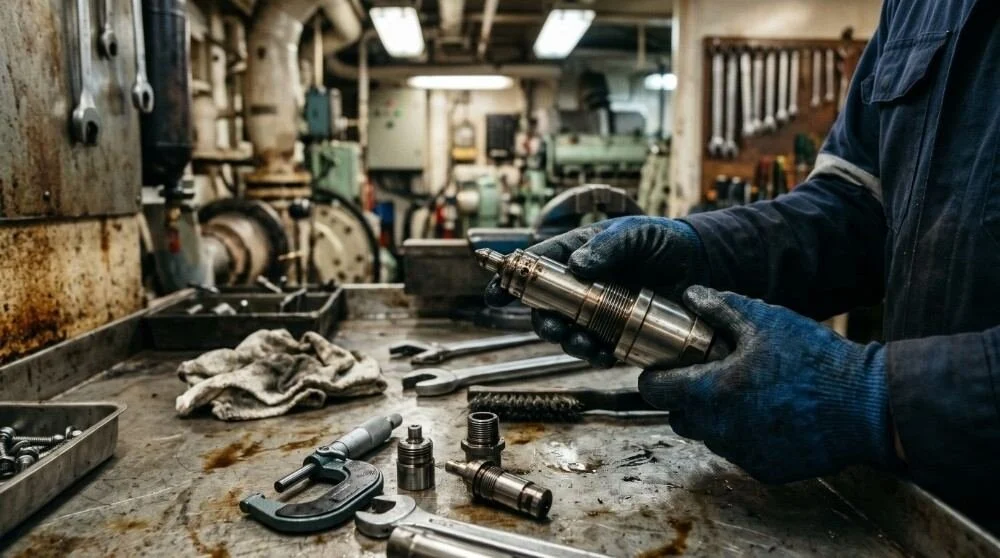
After safely isolating the fuel system, depressurizing it and removing the injector according to the OEM procedure, inspect the assembly for:
- Carbon accumulation around the nozzle tip
- External fuel leakage
- Corrosion or mechanical damage
- Damaged sealing surfaces
- Signs of overheating
Visual inspection can identify obvious defects, but it cannot confirm the injector’s complete operating condition.
3. Check Injector Opening Pressure
For conventional mechanically operated injectors, a suitable injector testing bench can measure nozzle opening pressure.
The measured value must be compared with the manufacturer’s specification for that particular engine and injector type.
Incorrect opening pressure may indicate spring deterioration, incorrect adjustment or internal component wear.
Modern electronically controlled injectors require their specified diagnostic equipment and procedures rather than a conventional opening-pressure test.
4. Examine Spray Pattern and Leakage
Where permitted by the OEM testing procedure, the injector can be checked for spray distribution and nozzle leakage.
An acceptable spray pattern should meet the manufacturer’s requirements without abnormal streams, uneven distribution or unwanted dribbling.
Safety note: High-pressure fuel can penetrate the skin and cause severe injury. Never place hands near a pressurized nozzle or attempt to assess the spray directly. Use approved enclosed testing equipment and protective procedures.
When Should a Marine Fuel Injector Be Replaced?
Not every faulty injector requires complete replacement. Some conventional injector assemblies can be overhauled using approved replacement nozzles, springs, seals and other serviceable components.
However, replacement is generally appropriate when:
- The nozzle needle or seating surfaces are excessively worn.
- The injector fails specified pressure or leakage tests.
- The nozzle body is cracked or mechanically damaged.
- Reconditioning cannot restore acceptable performance.
- The component has reached a mandatory replacement limit specified by the manufacturer.
For older marine engines, sourcing a compatible replacement can be challenging, especially when original components are no longer readily available.
Ship operators can explore main engine spare parts supplied by Labdhi Marine when planning engine maintenance or arranging replacement components.
Marine Fuel Injector Replacement Procedure
Injector replacement must be carried out using the relevant engine maintenance manual. Although individual procedures vary, the general workflow follows a consistent sequence.
Step 1: Prepare the engine
Stop and secure the engine, isolate the relevant systems and confirm that fuel pressure has been safely released. Allow components to cool sufficiently before maintenance.
Step 2: Remove the injector
Disconnect the required fuel connections and remove the injector using the manufacturer’s specified tools. Protect exposed fuel connections against contamination.
Step 3: Inspect the mounting arrangement
Check the injector seating area, sealing surfaces and associated components for damage or deposits. Replace sealing elements as required.
Step 4: Install the replacement injector
Confirm the replacement injector’s part number, specification and compatibility. Install it using the prescribed tightening sequence, torque values and sealing arrangements.
Step 5: Conduct operational checks
After restoring the system and completing the required checks, monitor for leakage, abnormal combustion, exhaust temperature differences and unusual engine noise.
The replacement should be recorded in the vessel’s planned maintenance system, including running hours, injector identification and test results.
How to Extend Marine Fuel Injector Service Life
Preventive maintenance is considerably more economical than dealing with cylinder damage caused by prolonged injection problems.
Fuel cleanliness should remain a priority. Filters and purifiers must be maintained according to the vessel’s fuel treatment requirements.
Engineers should also monitor exhaust temperatures, cylinder performance and fuel consumption trends. Sudden changes often provide useful evidence of developing injection problems.
Injector inspection and overhaul intervals should follow OEM recommendations, taking account of fuel characteristics, engine operating conditions and previous test results.
Maintaining suitable spare injectors or nozzle assemblies onboard can also reduce downtime when defects are discovered during operation.
Sourcing Marine Fuel Injectors and Engine Spare Parts
Correct part identification is essential when purchasing replacement injection equipment.
Engine model, serial number, injector assembly number and nozzle specifications should be confirmed before ordering. Similar-looking injectors are not necessarily interchangeable.
Labdhi Marine supplies marine engine spare parts for main and auxiliary engines, supporting shipowners, fleet operators and marine repair companies with new and reconditioned components.
The company’s previously supplied marine spares include K45GFC injectors and a main engine injector testing bench, reflecting its experience with marine fuel injection equipment.
For injector or related engine spare parts requirements, buyers can contact Labdhi Marine with the engine details and required part numbers to discuss sourcing options.
Conclusion
Marine fuel injector problems should be investigated as soon as abnormal combustion symptoms appear. Black smoke, high exhaust temperatures, rough running and increased fuel consumption may indicate injector deterioration, although other engine systems must also be considered.
Accurate diagnosis, manufacturer-approved testing and timely replacement help maintain reliable engine operation and reduce the risk of expensive secondary damage.
For marine engineers and technical managers, consistent fuel system maintenance and access to correctly specified replacement parts remain essential to keeping vessels operational.