
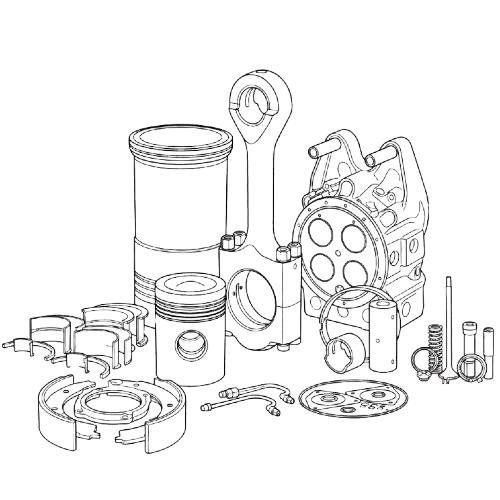
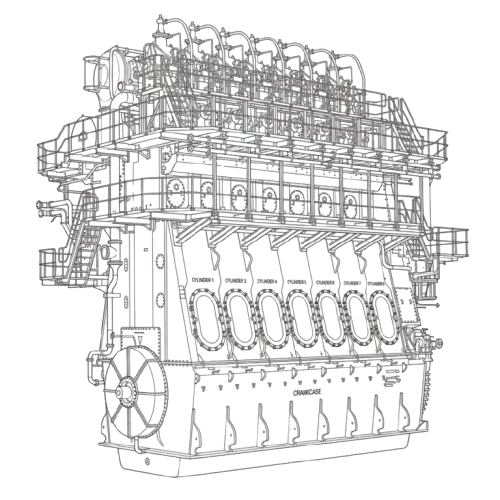


Buying a reconditioned marine engine component can reduce maintenance costs, particularly when a new OEM replacement has a long delivery lead time or is no longer readily available. However, the actual value of a reconditioned part depends on more than its purchase price.
A cylinder head may look freshly machined but still contain fatigue cracks. A crankshaft can appear polished while its journal dimensions fall outside acceptable limits. Even a correctly identified component may be unsuitable if its previous repairs have changed critical dimensions.
This is why reconditioned marine parts inspection should begin before the purchase order is issued, not after the component reaches the vessel.
For shipowners, technical superintendents, procurement teams, and marine engineers, the following inspection process helps distinguish properly restored equipment from parts that have merely been cleaned and repainted.
1. Confirm the Exact Engine Model and Part Compatibility
Before assessing physical condition, establish whether the component is correct for the intended engine.
Marine engines frequently have model-specific variations, even within the same manufacturer’s product family. Two visually similar components may differ in material specification, cooling arrangements, mounting dimensions, or design revisions.
Request and verify:
- Engine manufacturer, model, and serial number.
- OEM part number and superseded part numbers, where applicable.
- Component identification or casting number.
- Relevant technical drawings and dimensional specifications.
- Engine configuration and applicable modification history.
For example, a cylinder head intended for one engine variant may not have the same cooling passage arrangement as another. Installing an incorrect version can create sealing problems or affect cooling performance.
Compare the offered component against the engine’s illustrated parts catalogue and manufacturer service documentation.
For relevant component availability, explore Labdhi Marine’s Main Engine Spare Parts range.
2. Verify What Reconditioning Work Was Actually Performed
The terms used, refurbished, overhauled, and reconditioned are sometimes used interchangeably in spare parts quotations. They do not necessarily describe the same level of work.
A cleaned component is not automatically a reconditioned component.
Ask the supplier for a reconditioning report that identifies the original defects, repairs performed, parts replaced, inspection methods, and final acceptance results.
A meaningful report should answer three questions:
What was wrong with the component? For instance, excessive wear on a crankshaft journal or corrosion damage around a cylinder head cooling passage.
How was the defect corrected? This might involve controlled machining, approved welding, surface treatment, or replacement of damaged elements.
How was the repaired component verified? Look for post-repair measurements, pressure testing, non-destructive testing, or functional testing appropriate to the part.
A report stating only “checked and found satisfactory” provides little technical evidence.
Also clarify whether the component was restored to original dimensions or to an approved repair size. This distinction affects mating parts, bearing selection, assembly clearances, and future maintenance.
3. Conduct a Detailed Visual and Surface Inspection
Visual inspection remains valuable, but it should be carried out on clean, accessible surfaces under adequate lighting.
Look beyond the exterior finish. Fresh paint can conceal corrosion, previous repairs, and surface irregularities.
Pay particular attention to:
- Crankshafts: Journal scoring, overheating discoloration, fillet damage, and evidence of previous grinding.
- Cylinder heads: Cracks around valve seats, injector bores, combustion faces, and cooling passages.
- Connecting rods: Fretting around mating faces, damaged threads, distorted bores, and corrosion.
- Cylinder liners: Scuffing, pitting, polishing marks, and damage near port edges where applicable.
- Pistons: Crown erosion, ring-groove wear, skirt scoring, and evidence of overheating.
Surface finish alone cannot confirm internal integrity. A polished bearing journal may still have unacceptable geometry, while a properly machined surface may retain harmless visible tooling marks.
The decision must be based on measured condition and the manufacturer’s acceptance criteria.
4. Check Dimensional Accuracy Against OEM Tolerances
Dimensional inspection is one of the most important stages of evaluating reconditioned engine components.
Marine diesel engines operate under substantial mechanical and thermal loading. Excessive clearance, ovality, or misalignment can accelerate wear and lead to premature failure.
Depending on the component, measurements should include:
| Component | Critical measurements |
| Crankshaft | Journal diameter, ovality, taper, runout |
| Cylinder liner | Internal diameter, ovality, taper, wear profile |
| Connecting rod | Big-end bore geometry, small-end bore, centre-to-centre alignment |
| Cylinder head | Flatness, valve seat dimensions, guide clearance |
| Piston | Skirt diameter, ring-groove clearance, pin bore condition |
Measurements should be taken using calibrated instruments, with the results recorded in a dimensional inspection report.
The report should identify the measurement locations, actual readings, applicable limits, and acceptance status.
Do not accept a generic statement such as “within standard tolerance” without supporting numerical values.
Importantly, there is no single acceptable wear limit for all marine diesel engines. The correct limits depend on the manufacturer, engine type, component design, and approved repair specifications.
5. Request Non-Destructive Testing Reports
Some of the most serious defects in reconditioned marine components are not visible during routine inspection.
Non-destructive testing (NDT) helps identify cracks and discontinuities without damaging the component.
Common inspection methods include:
- Magnetic Particle Testing (MT): Used to detect surface and near-surface discontinuities in ferromagnetic components.
- Dye Penetrant Testing (PT): Identifies surface-breaking defects in suitable non-porous materials.
- Ultrasonic Testing (UT): Helps detect internal flaws in components with suitable geometry and material properties.
The testing method should match the component material, geometry, and expected defect locations.
For example, crankshaft fillets require particular attention because they experience repeated bending and torsional stresses.
Ask for test reports identifying the inspection areas, procedures, results, technician qualifications, and acceptance criteria.
Not every component requires every NDT method. However, for highly stressed structural or rotating components, missing inspection evidence should prompt further investigation.
6. Review Functional and Pressure Testing Results
Dimensional accuracy does not necessarily prove that a component will function correctly.
Certain reconditioned assemblies require operational testing under specified conditions.
For example:
Cylinder heads: Cooling passages may require pressure testing to identify leakage between water spaces and combustion-related areas.
Fuel injection equipment: Depending on the design, testing may involve injection pressure, leakage, delivery characteristics, or spray performance.
Turbochargers: Rotating assemblies may require balancing records, bearing clearance verification, and other manufacturer-prescribed checks.
Pumps: Performance tests may assess discharge pressure, flow characteristics, leakage, and operational behaviour.
For marine turbocharger spares, balancing records are particularly relevant when purchasing reconditioned rotating assemblies.
Ask whether tests were performed before or after the final reconditioning process. Post-repair results provide more useful evidence of the component’s condition at dispatch.
7. Check Traceability, Certification, and Supplier Documentation
An inspection report is only useful when it can be traced to the actual component being purchased.
Match serial numbers, identification marks, and report references against photographs of the offered part.
For critical components, verify whether supporting documentation includes material identification, repair history, inspection reports, and applicable certification.
Classification society requirements should also be considered where relevant. Approval or acceptance may be necessary depending on the component, repair procedure, vessel classification, and intended installation.
Do not assume that a general supplier quality certificate automatically constitutes class approval.
For additional guidance on verifying component identity, read Labdhi Marine’s article on How to Identify Genuine Marine Spare Parts.
8. Evaluate the Real Cost Before Approving the Purchase
A lower quotation does not always mean a lower maintenance cost.
Consider the total cost of bringing the component into service, including transportation, installation, additional inspection, possible machining, and replacement of consumables.
A reconditioned cylinder head priced below a new replacement may still be economical if its inspection records are complete and its remaining condition is acceptable.
However, an undocumented component requiring further repairs can quickly eliminate the original savings.
The purchase decision should reflect operational criticality. Components whose failure could cause extensive engine damage deserve greater scrutiny than easily replaceable, non-critical items.
Before confirming an order, request a written clarification of the part’s condition, included documentation, testing scope, and agreed return or warranty terms.
9. Use a Final Pre-Purchase Inspection Checklist
Before issuing the purchase order, verify that:
- The engine model and part number match.
- The reconditioning scope is clearly documented.
- Critical dimensions meet the applicable specifications.
- Relevant NDT and functional test results are available.
- Previous repairs and modifications are disclosed.
- Identification numbers match the supporting records.
- Required technical or classification approvals are confirmed.
- Packaging, preservation, and delivery conditions are agreed.
Any unresolved technical discrepancy should be reviewed before purchase, particularly for critical engine components.
Conclusion
A successful reconditioned marine parts inspection is not about finding a component that looks new. It is about establishing whether the part is technically suitable, properly restored, and supported by reliable inspection evidence.
Dimensional reports, repair records, defect testing, and compatibility verification provide a stronger basis for purchasing decisions than appearance or price alone.
Labdhi Marine supplies OEM and reconditioned marine engine spare parts for main and auxiliary engines, supporting shipowners, maintenance teams, and repair yards with sourcing requirements worldwide.
If you are looking for a specific component, contact Labdhi Marine with your engine model, part number, and technical requirements to discuss available options and supporting documentation.