

Oil pollution is a major environmental concern in the maritime industry. Ships carrying crude oil and petroleum products must follow strict international regulations to prevent oil-contaminated water from entering the sea.
Oil Discharge Monitoring Equipment (ODME) plays an essential role in preventing marine oil pollution. It is designed to monitor and control the discharge of oily mixtures from oil tanker cargo areas while supporting compliance with MARPOL Annex I regulations.
In this guide, we explain what ODME is, how it works, its main components, regulatory requirements, applications, and maintenance.
What Is Oil Discharge Monitoring Equipment (ODME)?
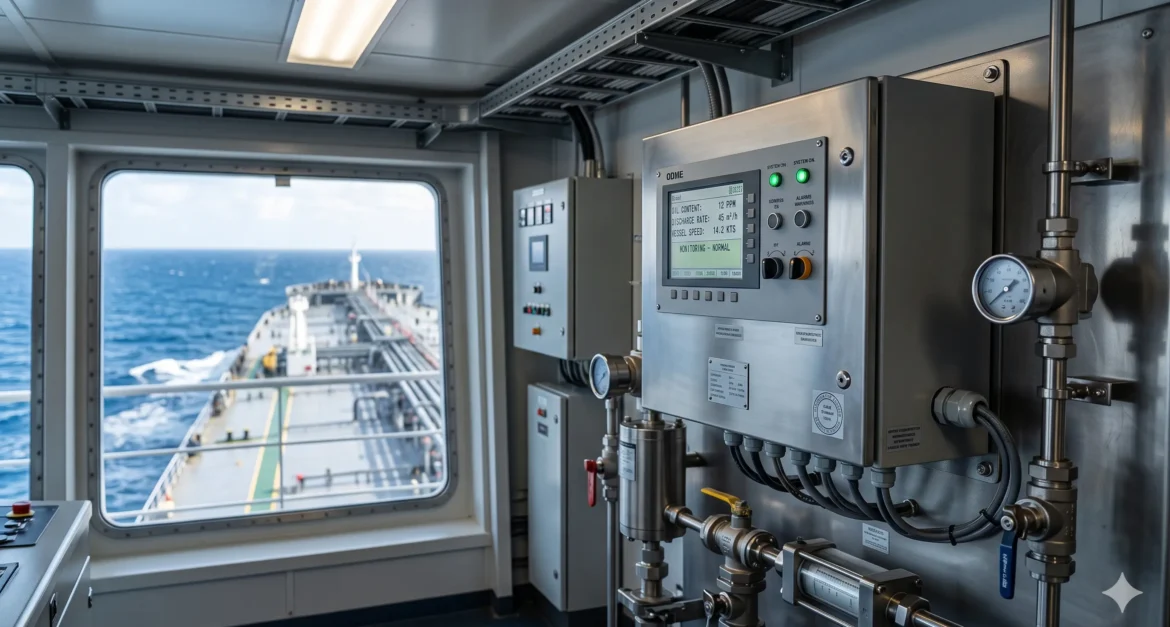
Oil Discharge Monitoring Equipment (ODME) is an automated marine monitoring and control system installed on oil tankers to measure and regulate the discharge of oil-contaminated water from cargo-related operations.
The system continuously monitors oil concentration, discharge flow rate, and vessel speed to calculate the instantaneous oil discharge rate and total quantity of oil discharged.
If monitored discharge limits are exceeded, the ODME activates alarms and automatically initiates the required discharge-stopping function.
ODME is commonly used during cargo tank washing, oily ballast discharge, and slop tank discharge operations where discharge is legally permitted.
Its primary purpose is to help prevent illegal oil discharge and protect the marine environment.
How Does an ODME System Work?
The ODME working principle involves continuously measuring the oil content of discharge water and calculating the quantity of oil being released into the sea.
The system operates through the following stages:
1. Water Sampling: A sampling arrangement collects representative water samples from the discharge pipeline.
2. Oil Concentration Measurement: An oil-content meter measures the concentration of oil in the water, generally expressed in parts per million (ppm).
3. Flow Rate Measurement: A flowmeter measures the volume of water passing through the discharge pipeline.
4. Vessel Speed Monitoring: The ODME receives vessel speed information to calculate oil discharge per nautical mile.
5. Discharge Rate Calculation: The control unit processes oil concentration, discharge flow, and vessel speed data.
6. Automatic Discharge Control: If applicable monitored limits are exceeded or required system conditions are not satisfied, the ODME initiates an alarm and the approved stopping arrangement.
7. Data Recording: The system records discharge information for regulatory inspection and operational verification.
This automated monitoring process helps ensure that tanker discharge operations remain within applicable environmental limits.
Main Components of Oil Discharge Monitoring Equipment
A typical ODME system consists of several important components working together.
1. Oil Content Meter
Measures the oil concentration in discharge water and provides information to the monitoring system.
2. Sampling System
Collects representative water samples through sampling pipes, pumps, valves, and associated fittings.
3. Flowmeter
Measures the discharge flow rate required to calculate the quantity of oil being discharged.
4. ODME Control Unit
Processes measurement data, calculates discharge rates, monitors operating limits, and controls alarms and stopping functions.
5. Vessel Speed Input
Provides speed information used to calculate the instantaneous oil discharge rate per nautical mile.
6. Automatic Stopping Arrangement
Stops or diverts overboard discharge when required by the approved monitoring and control system.
7. Display and Recording Unit
Displays operating parameters, fault indications, and discharge information while maintaining the required records.
Proper functioning of these components is essential for reliable ODME operation.
MARPOL Annex I Regulations for ODME
The International Maritime Organization (IMO) regulates oil pollution prevention through MARPOL Annex I.
Under Regulation 34, certain oil tanker cargo-area discharges are permitted outside special areas only when strict conditions are satisfied.
Important requirements include:
- The tanker must be more than 50 nautical miles from the nearest land.
- The vessel must be proceeding en route.
- The instantaneous oil discharge rate must not exceed 30 litres per nautical mile.
- The total oil discharged must remain within the applicable cargo-related limit.
- The tanker must have the required operational ODME and slop tank arrangements.
The total quantity of oil discharged is generally limited to 1/15,000 or 1/30,000 of the relevant cargo quantity, depending on the vessel’s applicable regulatory category.
Special areas have stricter discharge restrictions.
Important: Meeting the 30 litres-per-nautical-mile limit alone does not authorize discharge. Every applicable MARPOL condition must be satisfied.
Which Ships Require ODME?
ODME is generally required on oil tankers of 150 gross tonnage and above, subject to applicable MARPOL provisions and exemptions.
Vessels commonly equipped with ODME include:
- Crude oil tankers
- Product tankers
- Petroleum cargo tankers
- Combination carriers subject to oil tanker requirements
The exact installation requirements depend on vessel classification, size, operating arrangements, and applicable regulations.
Difference Between ODME and Oily Water Separator (OWS)
Although ODME and Oily Water Separators (OWS) both support marine pollution prevention, their functions are different.
| Feature | ODME | OWS |
| Main Function | Monitors and controls oil discharge | Separates oil from water |
| Application | Oil tanker cargo areas | Machinery-space bilge systems |
| Key Measurement | Oil concentration and discharge rate | Oil content of treated water |
| Relevant Limit | 30 L/NM, subject to other conditions | Generally 15 ppm |
| Oil Separation | No | Yes |
ODME monitors cargo-related oily water discharge, while an OWS physically separates oil from machinery-space bilge water.
Common ODME Problems and Maintenance
Regular ODME maintenance is essential for accurate monitoring and reliable operation.
Common ODME problems include:
- Incorrect oil concentration readings
- Blocked sampling lines
- Faulty sampling pumps
- Flowmeter malfunctions
- Missing vessel speed signals
- Control unit faults
- Electrical connection problems
- Automatic stopping arrangement failures
Routine maintenance may involve cleaning measuring chambers, inspecting sampling systems, checking electrical connections, verifying flowmeter readings, and testing alarms.
Calibration and servicing must follow the manufacturer’s instructions and applicable approval requirements.
If the ODME becomes defective, the crew must follow the applicable regulations and approved procedures rather than bypassing the system.
Important ODME Spare Parts
ODME systems contain electrical, electronic, and mechanical components that may require replacement during maintenance.
Common ODME spare parts include:
- Oil content sensors
- Sampling pumps
- Flowmeters
- Electronic control boards
- Display modules
- Power supply units
- Solenoid valves
- Relays and contactors
- Filters and strainers
- Electrical connectors and cables
When purchasing replacement components, always verify the manufacturer, model number, part number, electrical specifications, and compatibility with the approved system.
Marine Electrical Spares at Labdhi Marine
Labdhi Marine supplies marine electrical spares, automation components, control equipment, and industrial electrical products for ship maintenance and repair applications.
Reliable electrical components are essential for maintaining marine monitoring systems, control panels, and shipboard machinery.
For ODME-related electrical spare parts and other marine equipment requirements, customers can contact Labdhi Marine with the manufacturer, model number, part number, and available product photographs to inquire about suitable components.
Frequently Asked Questions (FAQs)
1. What is the full form of ODME?
ODME stands for Oil Discharge Monitoring Equipment, a system used to monitor and control oil tanker cargo-area oily water discharges.
2. What is the main purpose of ODME?
Its main purpose is to monitor oil discharge operations, prevent prohibited discharges, and support compliance with MARPOL Annex I.
3. What is the maximum oil discharge rate permitted under MARPOL?
For applicable oil tanker cargo-area discharges outside special areas, the instantaneous limit is 30 litres per nautical mile, subject to all other regulatory conditions.
4. Does ODME separate oil from water?
No. ODME monitors and controls discharge. Oil separation is performed by other equipment.
5. What are common ODME spare parts?
Common parts include oil sensors, sampling pumps, flowmeters, control boards, valves, relays, and power supplies.
Conclusion
Oil Discharge Monitoring Equipment (ODME) is an essential marine pollution prevention system used on oil tankers. By monitoring oil concentration, discharge flow, vessel speed, and discharge rates, ODME helps ensure compliance with MARPOL Annex I requirements.
Regular inspection, proper maintenance, and compatible spare parts are important for reliable ODME operation.
For marine electrical spares, automation components, and shipboard control equipment, contact Labdhi Marine for product inquiries and availability.